Your Cart is Empty
Width of the Glass
Measure straight across the glass from the point where the curve begins on the left to the corresponding point on the right.

Custom Hardware for Curved Windows
An arch or eyebrow window brings a graceful curve into the room, but a standard straight curtain rod can hide the very shape that makes the window special. A custom curved rod follows the line of the glass while sitting just outside the window frame, allowing the architecture to remain visible.
Measuring the window may look complicated at first, but the process becomes much easier when it is divided into two parts. First, measure the shape of the glass. Then decide where the rod and drapery should sit outside that shape.

Begin with the Glass
Measure the visible glass area—not the outside of the window trim or molding. The goal is to record the width of the curved opening and the vertical rise from the point where the curve begins to the highest point of the glass.
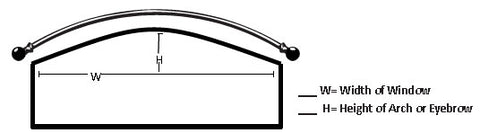
Measure straight across the glass from the point where the curve begins on the left to the corresponding point on the right.
Measure vertically from the horizontal line where the curve begins to the highest point at the center of the arch.
Measurement One
Width establishes the distance between the two points where the curve begins.
Identify the point on each side where the straight vertical portion of the glass transitions into the curved top.
Measure in a straight, level line from the left beginning point to the right beginning point.
Do not follow the curved edge of the glass with the tape.
Record the measurement in inches and label it clearly as W. Measure it a second time before moving on.
Measurement Two
When it is difficult to hold a tape directly from the beginning of the curve to the center peak, the height can be calculated using floor and ceiling reference measurements.

Measure from the floor at the side of the window to the point where the curve begins.
Measure from the side point where the curve begins straight up to the ceiling.
Measure from the floor at the center of the window to the highest point of the glass.
Measure from the highest point of the arch straight up to the ceiling.
Both calculations should produce the same result. A small difference usually means one of the reference measurements should be checked again.
Positioning the Finished Rod
The rod is mounted outside the glass area. The next measurements describe how far it should sit above and beyond the window.
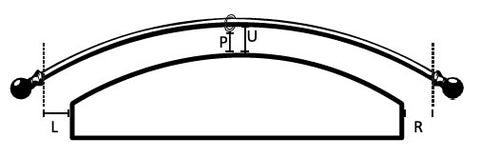
Measure from the highest point of the arch to the underside of the rod, without including rings.
When using rings, measure from the highest point of the arch to the top edge of the finished drapery panel.
Measure horizontally from the left edge of the glass to the base of the left finial.
Measure horizontally from the right edge of the glass to the base of the right finial.
Allowing for the Finished Treatment
The final drapery position depends on the rod curve, ring size, panel construction, and the upper placement selected.
U describes the underside of the bare rod. P describes the top edge of the drapery panel when rings are used. These are not the same location.
The last ring is generally located approximately one inch inside the L and R rod endpoints, depending on the rod curve and hardware selected.
L and R are horizontal extensions of the width. Depending on the curve and the selected U or P measurement, the rod may not descend fully to those horizontal reference points.
L and R end at the bases of the finials. Allow additional room beyond those measurements for the finials themselves.
Record whether the treatment uses rings, clips, tabs, ties, or another heading so the finished fabric position can be reviewed.
Curved rods are often used for stationary decorative panels. Discuss the intended movement before ordering when curtains need to open or close across the curve.
From Window Shape to Finished Rod
The glass measurements establish the underlying curve. The placement measurements position a larger, offset curve outside the window so there is room for the rod, rings, and fabric.
Width W and arch height H describe the size and rise of the visible curved glass.
This measurement determines how far above the glass the rod or top of the fabric should sit.
These measurements determine how far the rod extends beyond the glass before the finials begin.
Once the window shape and desired placement are known, the rod curve and projection can be calculated for the custom order.
Preparing the Custom Order
A clearly labeled sketch and several photographs help us understand the window and identify concerns before production.
Before Submitting the Order
Common Questions
Measure the visible glass area to establish W and H. Separate placement measurements determine how far the finished rod sits outside the glass.
No. W is a straight horizontal measurement, and H is a straight vertical measurement.
Use the floor-reference formula H = C − A or the ceiling-reference formula H = B − D. Both should produce the same result.
U measures to the underside of the rod without rings. P measures to the top edge of the finished drapery panel when rings are used.
No. W is the width of the curved glass. L and R are additional horizontal extensions beyond the left and right edges of the glass.
No. L and R end at the bases of the finials. Allow additional space for the decorative finials themselves.
L and R are straight horizontal extensions. The final endpoint height is also influenced by the curve and the selected upper placement measurement, U or P.
Recheck A, B, C, and D, making sure each measurement is vertical and taken from the same floor or ceiling reference.
Yes. Include the entire window, the curved glass, surrounding trim, the ceiling above, side clearances, and nearby obstructions.
Contact Iron Accents before ordering. Custom curved rods are made to the measurements supplied, so questions should be resolved before production.
Designed Around the Architecture
A properly measured curved rod preserves the graceful outline of an arch or eyebrow window rather than covering it with a straight horizontal line.
Review the window measurements, rod placement, rings, drapery construction, and surrounding clearances carefully. Contact the Iron Accents team before ordering whenever the window shape or measurements are uncertain.